O is for octopus

Spectre

Besides the Berlinale and “Leviathan”, I have not actually been to any movie theaters this year. As I already mentioned, my life has been shifting. Instead of watching movies, I watch operas in the evening, instead of watching anime I have been watching TV shows, and instead of going to movie theaters I have been going to the opera. All of this is actually because this is my last year in Berlin, and it will change next year: perhaps more books, but also more anime, more movie theaters and generally more movies. Nevertheless, there are always some films which I love to catch in theaters, namely more action-focused franchises I like, such as the Hobbit series. Those kinds of films are much less enjoyable on a small screen, in fact, I doubt I would even watch them on a small screen.

The 007 series is a special one. When I was a child, I saw all of the Pierce Brosnan ones when they came out on TV, and I caught a lot of the old ones too whenever they were on TV. My dad was a fan (though much unlike the rest of the world, he didn’t like Sean Connery), and I liked them too as a child. When I grew older, the Bond movies stuck in my mind as “mindless action” (much like the Indiana Jones series, which I never liked), and I thought of myself as better than the Bond films. When I started watching movies with more interest (around the time I started with this blog), I never took an interest in the Bond franchise even though I read articles about “Casino Royale”, how it changed the franchise and, well, that it had Eva Green in the story as Bond’s true love. All of that was not enticing enough for me until Pip and I got into this phase (around 2012) where we loved seeing action films on screen and went to the Downtown Crossing cinema so often that we had a loyalty card and regularly used it. That was when we saw “Skyfall” and I was blown away by its greatness.

Unsurprisingly, “Spectre” is comparably less great. As Pixelmatsch accurately pointed out, it’s a funnier film, it has a lovely Bond girl (even though she is being played by Léa Seydoux who always has these somewhat tired looking eyes) and its less ridiculously misogynist as “Skyfall” was with Sévérine’s silly death scene. Not even Judi Dench’s interesting and complex role in the story could have saved that. Nevertheless, “Spectre” is more action, it’s much more formulaic than “Skyfall” and its main antagonist pales against all the other evil guys in which Christoph Waltz was able to shine lately. Most importantly, “Spectre” lacked the depth that “Skyfall” surprisingly had (and I guess it is also unusual that it did), whereas Blofeld’s characterization never really went beyond a petty, jealous little boy. Despite my general sympathies for Seydoux’ character, she is a little bit too perfect: Extremely smart, young but sexy, can shoot a gun and say some tough things, she is pretty much every Bond fan’s female dream,

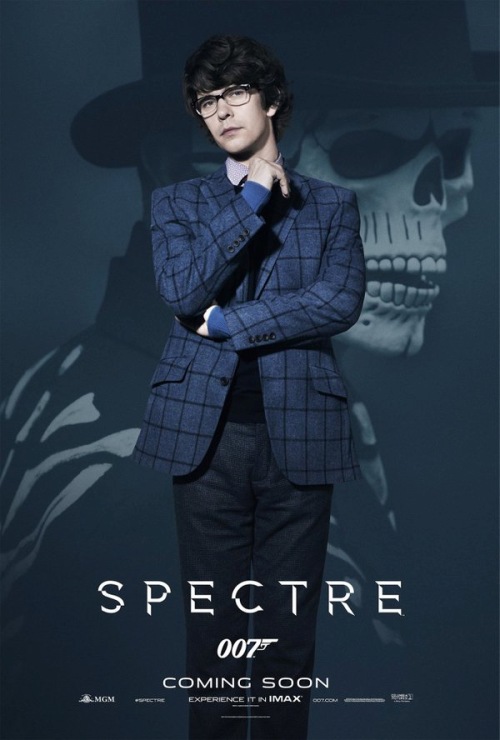
Speaking of lack of depth, I am so so giddily in love with Q and was happy to see that he got to do a little more than pounding away frantically on his keyboard. I thought Ben Whishaw was cute ever since “Cloud Atlas”, and the nerdiness aspect in Q amplifies that. Hah!

Overall, “Spectre” was much fun, and I feel lucky that we were able to catch it in theaters again. Despite the weaknesses I thought the film had, I am very much into the franchise now and would like to revisit all the old films too, even if only to revive those childhood memories.

Christmas shopping

The last few days have been exhausting, but shopping is actually part of the problem! This time, I bought quite a few expensive titles again (comics at half price are still expensive when it’s a hardcover book after all), but I am very pleased with what I got. I keep saying that shopping for books does to me what shopping for clothes does for other people.

IMG_20151203_225155866

  • Joseph Roth, Hotel Savoy
  • O. Henry, Das Geschenk der Weisen
  • Ursel Scheffler, Rufus hilft den Weihnachtsmännern

IMG_20151202_133826

  • Leo Tolstoi, Krieg und Frieden
  • Kate Beaton, Obacht Lumpenpack!
  • Agi/Okimoto, The Drops of God 1
  • Umberto Eco, Die geheimnisvolle Flamme der Königin Loana

When I was reading Hark A Vagrant book, I actually laughed out loud, so I look forward to the rest.

100GB of photos from 8 years

Finding Vivian Maier

When I finally was about to finish my month-long backlog, it also unsurprisingly sparked my interest in films again. As a result, I ended up seeing two films I have been wanting to see forever, “Revolutionary Road” and this one, and I finally dragged myself into a movie theater with the help of Pixelmatsch and the wife for “Spectre”. It’s entirely possible that these will be the last movies I will see this year, which means I saw 20 films at the Berlinale and 25 throughout the year. (Wow, that’s an all-time low!)

“Finding Vivian Maier” is the kind of film I normally never see. I like the documentary style for fiction films, like “My Winnipeg” or (more broadly) “District 9”, but usually I have to be really into the topic to see a documentary. The times when saw films like “Bowling for Columbine” (actually with school, shocking!) to educate ourselves are definitely over. But the story about Vivian Maier is a little special. I think that John Maloof did a great job telling his story, who crafted the film in a very accessible way such that it kept my interest throughout the entire film.

More than the talented film-making, however, I was absolutely smitten by Vivian Maier herself. Well, the movie does a good job at showing you how mysterious, then how amazing and finally how creepy she was. I thought it was fascinating how the sad end of her life brought out all those dark parts . If I had to take a guess, I don’t think anything bad really happened to her in life when she was a child. She was just a very special person with a very special eye. But since being special is generally a very hard thing in this world, I am not surprised that circumstances and the general ugliness of the world led her sensible character into exploring the darkness of humanity and then, well, becoming a pretty dark person herself. That she most likely mistreated some of the children she worked with is just one aspect of hers and it offsets her general amazingness.

Honestly, before the mistreatment of the children was mentioned, you’d think she was the perfect human being by today’s standards, the kind that Naoki Urasawa would turn into his female main character. (I am saying this because I used to hate how his female main characters are always libido-less saints or filthy whores, as if you can only be a good woman if men are completely irrelevant to you.) Vivian Maier loved children (I assume the mistreatment only came later), had a really good way with people, always stayed single, had a truly open mind towards the world and sympathy for lovers, children and less privileged people. She liked the outdoors, she worked for herself and not for recognition, she did a one year trip around the world way before it was hip and she was originally French too. On top of all that, her photos are jaw-droppingly good and the movie works them in so beautifully that you cannot help but be astonished by them. Heck, she was so cool that she used a Rolleiflex! The Maloof guy is surely doing a great job curating the myriads of photos that she took in her life. Towards the half of the film, I honestly thought that Vivian Maier makes a idol to strive for, though the creepy parts definitely offset that for me.

The movie is a great introduction to Vivian Maier’s work, and I thought that her life was incredibly interesting too. I’m glad that her works, which came so close to disappear forever, actually got the recognition they deserve now. It’s a sweet little fairytale.

I think I have never been to Salzburg

Considering that I have yet to see a single one of her films, I have always been fascinated by Chantal Akerman. That Gorp adores her and mentions her every once in awhile does not explain it in full. From a country that has never been famous for making good movies (nor producing a good national soccer team till recently), I have always perceived Akerman as the odd one out in the film business, but in a good way. I have seen snippets of “Jeanne Dielman”, namely some of those infamous scenes in which she prepares food monotonously, and have simultaneously admired and feared her ways of filmmaking. Without seeing her films, I have followed her in the news and thought the film on her mother must be very interesting. When she died this year, I honestly felt shocked and told myself this would be a good opportunity to see one of her films.

Then, when writing my posting for “Top Hat”, I stumbled upon the theory that Isabelle’s defloration scene in “The Dreamers” is a reference to Chantal Akerman’s “J’ai faim, j’ai fraud”, and so I set out to see some of her short films.

jaifaimjaifroid

J’ai faim, j’ai froid

Judging by how much these girls are eating within mere 12 minutes of screentime, you’d think this is a Korean short film. But platitudes aside, this is an amusing little film whose dialogue almost made me laugh out loud a few times, even though it wasn’t overly funny. These characters are a construct and the dialogue is a construct too, but by playing the fools in the kingdom and ignoring all social conventions, they show us how absurd the world is: They don’t pay for their food, they run away from home, they don’t care for any connection that sex and love could or should have. You’d think the natural consequence for them is to enter prostitution and a destitute life, but they sure don’t seem to care or even see it that way. These girls are perfectly fine the way they are, which I find reminiscent of Nouvelle Vague films.

sautemaville

Saute ma ville

It’s so obvious that this is an early film. I don’t think I have ever seen such a good, blatantly low budget film. It only has sound coming from the off, spoken by Chantal Akerman herself, and there is only one character, also herself. She could have made the movie with simply a camera, a sound recorder and her own apartment for all I know, like Cindy Sherman’s early works. (Who is not completely in awe of Cindy Sherman?) Technicalities aside, this is one heck of a weird movie. It feels weird, off, and annoying at times because, well, the protagonist is an annoying crazy person. But that is only one part of it. The message of the film is rather clear: This is a young woman breaking out from the constraints of her life by descending into madness, and as such she has all my sympathies.
Ultimately, I was less excited by “Saute ma ville” than I was for the utterly stylish and more lighthearted “J’ai faim, j’ai fraud”, but in retrospect I really liked the film, especially for its concept and its almost hilarious ending (in a black humor kind of way).

I love tea

herzogblaubartsburg

Herzog Blaubarts Burg

I often wonder what qualifies a film for this site. As you may all know, I am a completist and strive to blog everything I watch, but what does “everything” mean? I blog anime when it’s a more or less standalone film (like the amazingly fantastic “Disappearance of Haruhi Suzumiya”), I blog TV films like Ingmar Bergman’s fascinating “Welt am Draht”, I also blog films that have multiple parts (I would have blogged Kieslowski’s “Decalogue” if I didn’t end up dropping the series in the 10th film), but I don’t blog TV series. When I ask myself if I will blog a certain film, I tend to look at my previous decisions. In this case, this is an opera adaptation made for TV, and there is another precedent in my blog for this, namely Ingmar Bergman’s “Trollflöjten”. So here we are.

However, this little film is nothing to write home about. I care little for this adaptation which looks kind of lackluster and aesthetically a little weird. I actually enjoy some of its weirdness, but it reminded me of “Secretary” in the sense that I thought the aesthetics were a little off. Nevertheless, the characters have no chemistry whatsoever, and the adaptation completely ignores how utterly erotic the opera is, both in its libretto and its music. I have never seen Michael Powell film before, but I am curious in “Peeping Tom” and “The Tales of Hoffmann”. I suspect that this film is actually nothing like his other films and that it probably tells me nothing about them. So my curiosity remains.

As a result, my main motivation to write this blog posting (besides trying to be consistent with my decision to blog “Trollflöjten”) is my desire to simply write about the opera. I don’t blog operas, but sometimes I actually feel like it when one blows my mind as much as this Bartók gem did. I have never been a big fan of the Bluebeard topos, so this opera surpassed my expectations. When I saw it the first time at the Komische Oper in a production by Calixto Bieito (yeah, I know, a hit or miss), I perceived the production as bleak, dark and a little too bloody, but oh man, I adored the lady who played Judith. She had such incredible energy that she felt equivalent to Bluebeard who was towering over her so much that she had to stand on her tiptoes to kiss him. This opera is everything I have always wished for: A smart libretto for a chamber piece of only two people, an incredibly intense and erotic relationship drama (which is ultimately murderously dysfunctional) and, uh, a female main character I can identify with. Judith is not just an ignorant victim like the women in the Bluebeard stories often are, but she ruthlessly fights for her love and the curiosity that comes with it. No matter how questionable her actions are, I am struck by how passionate her forcefulness is. I almost suspect that Bartók called her Judith because she is just as strong-willed as the biblical one, and in her story, she is the one who acts.

When I looked up the opera awhile ago, it was played together with Poulenc’s “La Voix Humaine” (while I have seen it together with “Gianni Schicchi” which is a weird combination). I can totally see the parallels: Both are dysfunctional love stories full of devastating obsession, both are chamber operas with only two characters and both have a libretto that touched me to the core. It is surprising to me that an almost lifeless feeling production can take out of it so much, and it makes me curious for other versions of the opera. I strongly suspect that Powell’s “Tales of Hoffmann” will be better than this (because that opera can get pretty far with spectacle and costumes alone).

*points at pig* Who is this? Me!

francesha

Frances Ha

O will get an operation tomorrow. It’s a very small procedure and the likelihood of anything going wrong is very small, but I am grateful to everybody for being so understanding that I am worried because of course any operation comes with a risk, no matter how small. At the same time, the recent events in Paris have heightened my sense of insecurity (while making me re-think my own political opinions), and it’s not entirely unrelated to my worries about O either. After all, we have a special relationship with Paris and if if wasn’t for Paris, O wouldn’t even exist.

Compared to that, I have absolutely no feelings for New York, except for a sort of love-hate relationship with it. If 9/11 happened again, I would probably feel less bad than back then even. I have lived in Philadelphia and Boston, and prefer both cities to New York because they are less, well, overrated. At the same time, as a person I am not particularly Parisian. I’m not skinny, I don’t smoke, I don’t wear stylish clothing and I don’t make my child cry to his sleep and drop him off at a crèche at a few months old. (I know these are all clichés, but if you want to blame someone, put it on Pamela Druckerman.) But I fulfill all the clichés of the typical New York City lady: overly worried, slightly neurotic, somewhat intellectual but not in the French way (but somehow smitten with the French), somehow artistic, proud of putting loads of time and money and thought into your own offspring. The only international newspaper I read is the New York Times, and Joanna Goddard is my idol, except for her latent beliefs in in esoteric crap. (So is Vivian Maier, and I will get to her at some point too.)

Because of this, “Frances Ha” hit a nerve. I don’t think I have ever seen a movie describing my 25 year old self so well as this film. While my life’s circumstances are so utterly different from hers (I had a pretty stable, potentially lucrative job, I have no female bestie and my friends are significantly less quirky), I have never seen a female character on screen that I could so strongly identify with. The New Yorkian style of hipsterness that Frances Halladay embodies is scaringly familiar to me, and I am sure this is because Greta Gerwig was actually able to put herself into the film. I’m in awe of how well it works in the film, and it is narrowly beaten by “Before Midnight” for my favorite film of 2013. (It does narrowly beat “Inside Llewyn Davis”, which is quite amazing if I think about it. I adore that movie and thanks to Loris I own it too.)

The only thing that gives “Frances Ha” a small dent into its awesomeness (of no fault of its own) is the fact that Greta Gerwig and Noah Baumbach are a couple. It bothers me so much that she was able to influence the screenplay so deeply because she is fucking the director. She would definitely not have gotten the chance to make “Frances Ha” if she wasn’t in this relationship, and it’s just another example for the sad state of the film-making business.

I actually have strong doubts that Baumbach and Gerwig could ever make something even remotely as good as “Frances Ha”, this is how much I liked this slice-of-life-y quirky little story of a struggling performance artist.

PS. Also yes, we are definitely Generation Frances Ha. That leaves a rather sad aftertaste when you think about the Paris bombings a bit, but let’s just enjoy our little film.

I will miss the next Berlinale

anamericaninparis

An American in Paris

Ever since John Michael McDonagh praised the Zoopalast’s curtains at Calvary’s premiere as “Vincente Minnelli curtains”, I have been (1) trying to see as many Berlinale films in the Zoopalast as possible and (2) desiring to discover Vincente Minnelli’s films. At that point, I think I had seen none, and “Yolanda and the Thief” (not in the Zoopalast sadly) was the first. “An American in Paris” is generally regarded as one of his best, and even though it lacks Fred Astaire in my book, I can see where this assessment is coming from.

On a side note, the Zoopalast curtains are so iconic that they prominently appear along with the Zoo Palast logo in the Deutsche Oper’s production of Prokofiev’s “The Love for Three Oranges”, which is full of cute references to Berlin itself. But if you google pictures of the Zoopalast, none of them properly convey how majestic those bright yellow-golden curtains are.

As for “An American in Paris”, the storyline is bad to the point of being infuriating (but except for “Les Parapluies de Cherbourg” this is the case with all musicals after all), and I am not a big fan of Gene Kelly nor the girl who plays Lise. If you ask me, I would much prefer Fred Astaire and Lucille Bremer who was an utterly pretty face in my book. It’s unfortunate that “Yolanda and the Thief” was such an absurdity, whereas “An American in Paris” got all those beautiful stage sets and amazing musical choreographies, and on top of all that, the Gershwin genius for its music. The film as a whole might not be super watchable, but if you ignore the story, its musical numbers and dances are so fantastic it makes up for all the other weaknesses.

I don’t think McDonagh tried to say that the Zoopalast was style over substance by comparing its looks to Minnelli (because ultimately the Zoopalast is a very fine, newly restored movie theater), but Minnelli’s films definitely are utterly stylish and I wish he had done opera stage sets.

My biggest dream is to die in my sleep one day

watashiwanisai

Watashi wa Nisai

After the Berlinale, I grew more interested in Kon Ichikawa’s films. He is not in my directors list, because I had only seen “The Makioka Sisters” and I didn’t really expect having an interest in him. I had no interest in his magnum opus “The Burmese Harp”, but somehow I should have known that there is more to him than that, just like I care little for Ozu’s “Tokyo Monogatari” or Kurosawa’s “Rashomon” or Mizoguchi’s “Ugetsu Monogatari”. By now, Pixelmatsch has seen a bunch of his films at the Berlinale, and so I looked into what else he has done. Since O is now two years old, it is a given that Pip and I wanted to see it. (When will the Myoron family watch a film together? And what shall it be?)

I still somehow don’t pin Kon Ichikawa as a genius like I thought Naruse was after seeing “Tsuruhachi Tsurujiro”, but we certainly liked “Watashi wa Nisai”. It didn’t make us laugh as much as we expected, and it didn’t make us go “this is just like O!”, but both events happened often enough for us to derive much pleasure from the film. As expected, not that much has changed in parenting in 50 years, even if the differences seem huge. Ultimately people all care for their children when they are young, and all children act however they want to some degree before society can successfully mold them into something.
Most of all, I actually really liked the adults: The dad is kind of a fool, and the mother is a worrywart, but all of them are lovely and take life with their child with a certain grain of salt. I enjoyed their utterly normal life, including the grandmother who spoils the child like crazy.

Even though “Watashi wa Nisai” did not generate a reaction as emotional as I expected, seeing it was exactly what we were looking for, and we enjoyed that a well-made slice of life with this particular premise even exists. Even if Kon Ichikawa’s other films were all lackluster, he has my gratitude for adapting the “Makioka Sisters” and our life with O.

Even Bae Doona couldn’t save it

airdoll

Air Doll

A few years ago, I had this conversation with Loris about Fukushima during which he postulated that Japanese culture is somehow inherently perverse. Shii made a similar observation about backpackers in Japan who somehow have this “Look at that! So this is why Japan is so screwed up” mindset and then discuss their culturalist findings with pretentious words. Shii was furious, and I was too back then. While it’s easy to argue that such a statement should never be made, we probably have to admit two things to ourselves: 1. There is an uncomfortable grain of truth in that statement and 2. it’s uncomfortable mostly because we are so into said culture.

More than subway gropings, lolicon porn and violence festivals à la “Battle Royale”, “Air Doll” represents what I think can only come out of some sick culture. I remember being actively appalled at the story and not wanting to watch any films for quite awhile because it was ultimately such a terrible experience.
I really like the concept, just like the science-fiction-minded part of me always loves the exploration of being that are somewhere between humans and machines. Ultimately, Nozomi is such a cyborg, except that she is also an inflatable sex doll. But this film actually explores none of the interesting questions about life, and the entire character of Nozomi is based on sex, and only the most degrading kind: She has sex with her owner, she is being coerced into sleeping with her boss (who seemed like a nice guy before that scene), and finally she attempts to have some sort of “relationship” with a guy which ends with her killing him in some wacky way. Actually she is a fetish for that guy too, and not exactly a nice one. Somehow her treatment throughout the film and her sad end just made me angry. This is worse than a woman being treated as a sex object, this is a quasi-human being treated as perverse fetishized object.

I have no idea how the director of the beautifully thoughtful “Like father, like son” is the same guy who also made “Still Walking” and “Air Doll”, both films in which characters act in the most despicable ways I have seen, and somehow I get the impression that nobody sees it.

I have not seen “The Dreamers” in years

tophat

Top Hat

It’s definitely been awhile since the last time I have seen “The Dreamers” which I told myself I would watch every year to assess how my love for films has changed. Without even seeing the film, one thing is for sure: I definitely outgrew it by now, and I have always known that I would one day. It actually makes me a little sad to have lost that youthful, foolish spirit, yet at the same time, a big part of me thinks that adulthood (and motherhood especially) actually made my life richer than the foolishness of youth, much unlike what your average Hollywood film would suggest. I read that Rohmer only makes movies about young people and I suspect his disdain for old people is merely more open than other people’s. Films like “Make way for tomorrow” or “Amour” are rare. But I digress. So I looked through my 2014 favourites list and realized that nothing has changed from it. I barely watched anything in 2015 and my sense of films has basically stagnated. This is dangerous, and I hope to improve on that in 2016.

“The Dreamers” is also the main reason why I want to see “Top Hat”, apart from the fact that I have never seen anything by the famous Rogers/Astaire couple. I also realized that “Top Hat” is actually their most famous film (or at least that is my impression), with none of the truly famous dance musicals of later days featuring any of them. I got the impression that the pair is more famous for themselves than their movies, and seeing “Top Hat” confirmed that for me. The storyline is nice, funny sometimes, but ultimately somewhat dull. It’s the music, the choreography and the ridiculous but stylish stage design that make 50% of the film’s appeal, and the other 50% is the unparalleled chemistry between Astaire and Rogers. I have never seen anything like that, and I doubt I ever will again. There is so much joy in the way they dance together that I never even thought of falling asleep for a second, even though it was late and some of the others either went to sleep or fell asleep during the film.

By the way, my favorite dance is actually not the one in which Rogers had all the feathers on her dress fly off, but the one where they initially seek shelter from the rain and fall in love. She wears pants in that scene, and somehow that made their moves much more appealing to me.

I definitely want to see “Swing Time”, even though I expect its story to be even worse. If the dances are good, I think I would accept the most absurd plot just to see Ginger Rogers and Fred Astaire dance, that’s for sure. It’s sad if “Top Hat” really is their best film, but then it’s definitely worth a second look.

* On a completely unrelated note: If you ask a female feminist who advocates for equality between men and women in all regards, she is on a sinking ship with a single male who offers her his life vest because she is a woman – would she refuse?