Berlinale 2017, Day 6 (Kurzfilme Kplus 1)

The event I have been anticipating for weeks is to attend a screening of the Berlinale with O. I saw that it’s recommended for 4 year olds (the only screening recommended for this young age group), and I was pleased to see that, of course, there would be plenty of overly eager parents with their 2 and 3 year olds. After 2 1/2 Berlinales of leaving O with my parents so I could attend the screenings, I am finally able to share the experience with him, yay!

We spent a very calm morning, took a nap from 10.30am to almost 1pm and got to the venue almost 45 minutes early. In fact, we were able to get in first and snatch two of those booster seat cushions such that Oskar’s head was almost at my height and he could see very well despite sitting in the comparably deeper (but very comfortable) special seats that you normally pay an additional fee for. The seats were so big that O asked “Have to put on your seat belt?”

It’s embarrassing to think about it, but when the Berlinale opening sequence was playing, I teared up, that is how much it meant to me that I am finally able to show the Berlinale to O. Ever since, O recognizes the Berlinale logo on all of my Berlinale bags…

As expected, O loved the experience. This was his first time in a cinema theater ever, and I was afraid he would be scared of the movie theater becoming very dark. I warned him beforehand and he saw that all the kids around him were not scared either, so it went very well. It helps that all the films were short, so even though there were some that he didn’t like as much (the second and the second to last) he was fine because he was anticipating the next story.

By the way, I ended up kicking out all other short film screenings from my Berlinale schedule this year because I somehow felt more like watching feature films this time. I saw a bunch of great short films with Shii in Uppsala, and I had doubts the Berlinale selection could surpass that.

After the film, we did not stay for the Q&A because O’s German is not good enough for him to understand and enjoy it, but we were able to get some postcards stamped with the adorable stamps by the same lady as 2015. O loved those stamps so much that he declared her film as his favorite – sounds like her marketing machine is working even better than I expected.

Later on, O was very excited all evening and it took him awhile to get settled for sleep, so I ended up leaving much later for my evening screening than I anticipated.

drrt

Sabaku
Netherlands 2016, Marlies van der Wel, 3′

A bird loves to sit on top of other animal’s heads, but whenever he opens his mouth, a huge loud trumpeting sound comes out and chaos ensues. Finally he gets to meet an elephant with whom he becomes best friends and they trumpet together while the bird sits on his head.
The kids loved aforementioned ensuing chaos, and O liked that there were lots of animals involved, but he didn’t seem to find it as funny as the other kids. I thought the film was cute, and a nice allegory on how everybody can find a suitable friend.

Dziedošais Hugo un vi?a neticamie piedz?vojumi (Singing Hugo and His Incredible Adventures)
Latvia 2017, Reinis Kalnaellis, 9′

Hugo, a chicken in a chicken coop, dreams of becoming a big star but his singing disturbs the other chicken and gets him abducted by chicken thieves. He gets sold to various places, a crazy chase ensues and Hugo accidentally ends up at a circus performance where he finally fulfills his dream.
I thought the story itself was enjoyable and nice, but the character design is significantly less cute than for most of the other segments, so O was less into it. I doubt O was a big fan of the action (or the sleazy human characters) either.

Odd er et egg (Odd is an egg)
Norway/Portugal 2016, Kristin Ulseth, 12′

Odd is the child of chicken and his head is essentially an egg that may break and thus needs a lot of attention and care. As a result, Odd has no friends because he can never play along with their dangerous ball games and the likes. One day, he meets a girl who dresses up like a bee and whose free spirit inspires him to shake off his fears, and she becomes his first precious friend.
When I saw that the story would involve an outcast school-aged child, I was worried that O would think the topic to be boring. I was so wrong, because the story was mostly about Odd and Gunn becoming friends – and O loves that! Even though he understood relatively little about what was said in the dialogues, he grasped that this is a heart-warming tale of two children becoming friends and doing fun things together, and that made him happy. I thought it was adorable too, even if the premise and the ending are also a little silly.

1Minuutje natuur (1Minute of Nature)
Netherlands 2016, Stefanie Visjager/Katinka Baehr, 7′

The film consists of five little segments of children talking about something of their lives for one minute, with some matching animation using stick characters and real-life objects as backgrounds.
I was not too into the style and O didn’t get how the animation illustrated what has been said. This film is actually a little more advanced than the others, but without really saying that much if you ask me. It was OK.

Der kleine Vogel und die Raupe (The Little Bird and the Caterpillar)
Switzerland 2017, Lena von Döhren, 4′

The little bird from two years ago still cannot fly, and befriends a caterpillar in this story who helps him get away from the mean fox.
Just like last time, this was extremely cutely animated and it surely helps for O that it had no dialogue at all. It seems like the films about the little bird are favorites with the audience every time. As for me, I already forgot what happened in the story, but I am glad that O had a good time and treasures his stamped postcard so much that it’s now hanging on his wall.

Hedgehog’s Home
Canada/Croatia 2016, Eva Cvijanovic, 10′

The hedgehog lives in modest housing within the forest. One day, the fox invites him to his house and offers him to stay over, but the hedgehog still prefers to go home. It’s a little tale about how your own home is always the best.
This is a classical fable with lots of dialogue and the animation is often dark and a little intimidating looking, especially with a bear, a fox and a wolf as characters. No wonder O wasn’t too into it, even though I thought the story itself was actually fine.

Jazzoo
Sweden 2016, Adam Marko-Nord, 9′

In these ultra short segments, various animals are doing fun things accompanied by jazzy music.
To me, this was the most humorous part of all of them, O really liked the colorful animation and the animals that were involved (in fact, it seems like he had a dream concerning one of the segments afterwards and then claimed he saw it in the cinema), and we were both very into the music. Sadly the parts were also so short that the content was ultimately not very memorable, but even so I remember I found it to be one of the best and most entertaining short films in the selection.
Berlinale 2017, Day 4 (Up in the Sky)

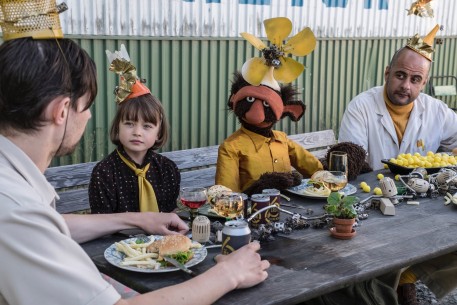
This was quite an experience. I have never been in the Haus der Kulturen der Welt, and I was quite afraid I wouldn’t get there in time since you have to take a bus there (and the 100 bus is not exactly famous for being very punctual). Luckily I got a bus right away (and I caught the shuttle bus on the way back too). In the end I was there 25 minutes early and was able to get a very good seat, even though I was sitting inmidst of a crowd of children. It turned out that this was a good thing, because kids talk to their friends and so I was able to hear firsthand what they thought about the film. They would comment “oh it’s so cute!” about the little robot, laugh out loud many times and generally be very vocal about their thoughts (largely they were ecstatic and loved it to pieces).

The screening also came with a Q&A but I was too busy to stay for its entirety, which is especially sad for this film because I really enjoy the questions asked by children. (Actually I didn’t really stay for any Q&A’s this year at all because there were so many other things going on at the same time. By the time I got less busy, the Berlinale was almost over and there were no Q&A’s anymore.) I listened for a few minutes and learned that the film’s puppet characters were actually part of a children’s TV series and the director designed the puppets and originally trained as puppeteer. Also, the little girl who plays the main character seems really professional and ambitious, the kind who has always dreamed of making it big as an actress. I actually wanted to learn more about the film, and find these Q&A’s to be one of the most interesting aspects of the Berlinale overall, but I have no regrets.

drrt

Upp i det blå (Up in the Sky)
Sweden 2016, Petter Lennstrand, 82′

Pottan’s parents are very busy and want to drop her off at a pony farm. Accidentally, she ends up at a recycling yard instead, where the team consists of a puppet who is supposed to be the boss but actually just talks a lot, an older puppet who likes to tinker with recycled things and a wanted criminal hiding out at the recycling yard. After they take in Pottan, she finds out that the chaotic but lovable group is trying to build a space ship, and soon they go on a quest to find a real rocket scientist to fulfill their dream.

Well, what can I say, “Up in the Sky” is the perfect children’s movie. It has wonderfully lovable, quirky characters tied together by a sweet friendship, even though or maybe because they all come with their own weaknesses. The film is funny, energetic and very knowledgeable about what children would get excited about in a story. Pottan is largely a generic main character, but she is not the kind of child adults imagine children would be like, but actually someone a child could relate to. Also, the kids in the audience especially loved the action-packed scenes in the second half of the film. Heck they even managed to work in a martial arts fighting scene.
I only found the busy parents a little over the top, because they go from completely not caring about her to suddenly becoming very attentive, but within a children’s movie this kind of exaggeration is fine, I suppose.

Did I ever mention that I think the name Pottan is really cute? I have a suspicion this cannot possibly be a real name, and a quick search on the internet suggests so as well.

I hope O will be ready for this film in a few years, and I think it’s actually a much more sophisticated and enjoyable film than most children’s films I have seen in the last few years. (Considering that just last year I saw “Zootopia”, “Finding Dory” and “Paddington”, this is quite a feat.)

Berlinale 2015, Day 9 (Kurzfilme Kplus 1)

Sunday in Berlin-Friedrichshain at 10.30am – needless to say that there were pooptons of children. This time it was not huge groups of school or kindergarten kids, but affluent and hipster looking parents trying to instill some culture into their children. The whole affair was quite loud, but it actually made the Q&A rather pleasant. As always, the children asked a lot of “why”-questions and most of them were really good. I really liked the answers given by Montoya who explained his film so well that I liked it more afterwards, and I was in love with the Iranian woman who appeared on-stage with a light headscarf and a very cutesy but elegant outfit. I was impressed by how child-like and thoughtful her answers were, though sometimes she overdid it a little bit (and the children actually did not believe her version of the world). On top of that, the lady from the first film had stamps with her film’s characters for the autograph session. The children were delighted and I thought that marketing scheme was brilliant.

drrt

Der kleine Vogel und das Eichhörnchen (The Little Bird and the Squirrel)
Switzerland 2014, Lena von Döhren, 5′

A short film about a bird and a squirrel fighting over something (food?) and then meeting a fox who tries to eat them. It looks utterly adorable and the kids laughed a lot, but I wasn’t a huge fan of the story itself. It seemed utterly pointless that the little bird couldn’t fly, and there was basically no point to the story except it had action that children like.

Camino del agua (Water Path)
Columbia 2014, Carlos Felipe Montoya, 8′

The story is really short – mother tells girl to go to a further away water source to fill up a bottle of water. She does so but on the way back a stranger with crutches asks her to give him water. She does so, but it turns out that the stranger lied to her and can actually walk just fine. She ends up filling up her bottle again at a pond, and a little fish gets caught in the water. I like how ambiguous the end is (we don’t know if she gets scolded, if the mother notices etc.) and especially how unclear the moral takeaway of the story is. Was her decision a “good” one?
Oh and how much I loved the little girl’s outfit! I was amazed at its cuteness. But I think all of these – ambivalent story, beautiful landscape, cute outfit – are things that little children don’t really care about. Only for adults like me it was truly fun.

The Tie
Belgium 2014, An Vrombaut, 7′
I think this one got an award for being visually impressive or something, but I thought it was remarkable that this was the only film I did not remember just from its title. It sure was beautifully rendered and features a cute idea, but its story was all but forgettable and I was not a huge fan of its style. But the children sure liked it.

Messages dans l’air (Air-Mail)
Switzerland/France 2014, Isabelle Favez, 6′

A cute little story and an awesome cat (see picture above! I loved the cat so much that I chose the picture for this blog post.) I doubt the children were very into it, but I certainly loved the style and enjoyed the sweet love story.

Agnes
Sweden 2014, Anja Lind, 15′

“Agnes” is the longest and one of the more meaningful stories in the bunch, about a 6-year old girl whose 16-year old brother is the most important person in her life. She experiences jealousy when he starts becoming alienated to her as he has a new girlfriend. But before it takes a real toll on their relationship, they reconcile. I didn’t fully get what was going on in their heads because it was all subtly hinted at, but I actually liked the way it was done.

Rosso Papavero
Slovak Republic 2014, Martin Smatana, 6′

A visually stunning dream sequence of a small boy who dreams of, well, a circus. The whole thing looked pretty surreal and the director actually said something about what it was supposed to mean, but I couldn’t understand his answer very well (sad!) One kid asked how those circus waggons could all disappear in a small tent, and his response was: “It’s a magic tent!” Cute.

Mahiye sorkh shodeh (The Fried Fish)
Iran 2014, Leila Khalilzadeh, 11′

Based on a Japanese children’s book, this is the story of a fish who gets caught, then fried but manages to escape being eaten. He offers a part of his body to animals who find him in exchange for taking him to the sea, but one by one they abandon him after eating his flesh. Ultimately quite a sad story, and I would have hated it as a kid. (What is the point of all this sadness?) I also was not a big fan of the animation which looked sloppily done. However, I really liked how it stirred up a lot of discussion with the children. (One of them complained that mice don’t eat fish hahaha.)

Berlinale 2014, Day 10 (Nymphomaniac, Vol. 1)

A month after the Berlinale started, I am finally blogging about the last film. I had a feeling this would happen and I was a little afraid about it. Luckily I have a very vivid memory of “Nymphomaniac, Vol. 1” which ended up making quite an impact on me, I think.

Fittingly for the Berlinale, we were in the Berlinale Palast for the last film, sitting upstairs in the first row in the very middle. Lucky! As you can imagine, it actually provided a great view onto the screen and considering that the film was almost 2 1/2 hours long, this definitely helped.

drrt

Nymphomaniac, Vol. 1 (long version)
Denmark/Germany/France/Belgium/Sweden 2013, Lars von Trier, 145’

On his way home, the old bachelor Seligman finds a woman beaten up and brings her to his home. When she gets better, she tells him the story of her life and how she became a nymphomaniac, as she diagnoses herself. Volume 1 covers the first five chapters, which detail her youth in which she competes with her best friend about who can get the most men to sleep with them; her first meeting with Jerome, the love of her life, an incident; her father’s death and finally how she meets Jerome again.
Death count: 1.

I read up on what happens in part 2, and I’m not liking it, especially the parts concerning Seligman. However, I haven’t seen it and if I see it I may change my mind, we’ll see. Here, we only saw the first part, and I have to say, I liked it. If you look beyond those explicit sex scenes (yeah yeah, they’re provocative etc., get over it, there’s not even that many of them), the characters in the story make a lot of sense. I don’t think Joe’s character is very common or typical or even “human”, if you want, but she must be seen as an individual. Most people in this world are not nymphomaniacs or anything like her, but her character is well-fleshed out, and so it is possible to relate to her. As somebody who is almost uncontrollably obsessed with sex and who seems to have an incredibly built-in desire for it, she is quite aware of what she is doing and what it means. The story is detailed as one in which she made her own choices – she may not have been very good at controlling her desires, but she had full control of her actions. My favorite part was the one with the crazy wife who intrudes into her life with her children and goes on a crying rampage. It was so damn realistic and I loved how Joe ends the story with the fact that it did not faze her emotionally at all. That part was just so fascinatingly realistic, and shows in a striking fashion what consequences her actions have on other people. The matter-of-fact way she talks about her “sins” is nice because honestly, if there is something people are usually absolutely cold about, it’s what happens to other people who sleep with the same person as you, most often those husbands or wives. It’s not even that psychopathic of her, it’s perfectly normal if we were honest about it. I think I am usually a rather compassionate person, but if some guy’s wife did that in my apartment, the only thing I would want to say to that would be “Get out.”
The realism and the subtle feminism (quite typical for Lars von Trier) are this film’s best aspects really. People are getting it wrong, he doesn’t hate women, he loves them.

My second favorite part of the story was the last one, in which she compares her lovers to different voices of an organ. One of them is Jerome, the love of her life. The film’s main quote is probably “The secret ingredient to sex is love”, but even though Jerome may be the only man amongst whom she loves, he is still only one of them, only a part of the “big picture”. It reminded me of analyses of the Don Juan character who I was extremely fascinated with when I was younger, and she is something like a reverse Don Juan with a psychology just as complex.

I really enjoyed seeing Stellan Skarsgard after “Kraftidioten”, especially since he is in such a different role here. Charlotte Gainsbourg not so much, but I don’t think there is any film in this world which could make me feel better about her. Her adoration of Lars von Trier’s dark side also creeps me out.

After disliking “Antichrist” and dropping “Melancholia” like 10 minutes into the film, I had surprisingly high expectations for “Nymphomaniac”, perhaps because of its premise and because I enjoy Lars von Trier’s provocations. I enjoyed the film and thought that it was rather interesting in the way it handled its heroine. At least in parts, Lars von Trier is in parts regaining the depths he has shown in his older films, like “Dogville” and “Idioterne”, and I am glad that he finally did after almost 10 years of dabbling when only his comedies (“Occupations” and “The boss of it all”) were good.

Berlinale 2014, Day 10 (Kraftidioten)

Pixelmatsch is a huge fan of Hans Petter Moland ever since he saw “En ganske snill man” at the Berlinale. I always thought that his Tarantino-like qualities were enticing, so “Kraftidioten” was a must for us to see, hence we got the Sunday tickets just to make sure.

I was already in the Friedrichstadtpalast for “La belle et la bete” right before, so I had the opportunity to secure pretty ideal seats for us. Yay!

drrt

Kraftidioten (In Order of Disappearance)
Norway/Sweden/Denmark 2013, Hans Petter Moland, 115’

When Nils hears that his son supposedly died of a drug overdose, he doesn’t believe in it and vows to get behind what happened and take revenge. Behind everybody’s backs, he finds out about the mafia deals his son got into, and starts killing the people involved one by one until he finds Greven, the boss of the organization, a megalomaniac, organic-food-and-pink-cupcakes-obsessed eccentric who is not afraid of random killing. Greven mistakenly thinks the Serbian mafia are responsible for the murders of his men, who are now plotting his son’s kidnapping.
Death count: Hehe, if I could remember. If I had to guess, 15.

I recently read a comment from somebody saying that the Scandinavian culture is rooted in violence and sadism, as can be seen in films like Lars von Trier’s. If you add in all the death metal scene, I can easily why someone would think that way. But then again, by that logic all of Japan is made up of pedophiles and Koreans are just as into violence too. I would be careful making such assumptions, even if they seem to make sense at first glance. But the truth is that the majority of Japanese people probably has nothing to do with pedophilia, as manga and anime give a skewed view of the country. I suspect this is the same thing for Scandinavia’s supposed propensity for violence. It just so happens that the kinds of Lars von Trier and Hans Petter Moland make it to the Berlinale, and perhaps they do make better films than their colleagues, but more than anything they just make for better headlines. It’s just like what Park Chan-wook’s films do for Korean cinema, even though many others (Bong Joon-ho, Hong Sang-soo, Lee Chang-dong) are at least just as great.

Actually “Kraftidioten” is not even that violent. Sure there is a lot of death, and it’s part of the film’s title. But it’s a black comedy, and as such, “Kraftidioten” is even funnier than “The Midnight After”. The violence comes from the amount of people dying (a lot) and the circumstances they die in (pretty random), but it’s not like you see a lot of blood or anything. “Kraftidioten” draws a thin line between film noir, Scandinavian deadpan comedy and revenge film, so death is almost inevitable. On top of that, almost every death case is important to the plot or at least has been foreshadowed. It’s a very well-crafted, stringent plot in which nothing happens just randomly, even though I just said that people die in random fashion. I blame the English language – people die in this film almost without any reason (which makes it a little shocking and perhaps hard to watch), but within this story everything has its place and every single “disappearance” advances the plot. (Except at the end where I am glad that they all got wiped out.)

One of my favorite aspects of the film is its use of snow and the stunning Norwegian landscapes. There is so incredibly much of it, and Nils’s profession (plowing the snow to clear the streets) has something very fitting for the film. It’s like the snow is another comedic character in this film’s ensemble.

I want to see “En Ganske Snill Mann”, and my high expectations for “Kraftidioten” were fully met. I don’t think I have laughed this much in awhile.