The best thing about having two films back to back at CinemaxX 8 is that they let you stay in the theater, and you just show them your ticket for the next film while inside. That way you are guaranteed to get your preferred seat because each time, only around 5-6 people end up staying. Actually I have never had a chance to try this at any other venue, but whenever I can, I jump at the chance to catch two Retrospektive films in a row. I almost went for four of such films, but realized that this may be too crazy after all (though “Strange Days” seems to be an interesting movie).
This is the first film I saw with somebody this year (if you don’t count that random meeting with Danish dude). Pixelmatsch didn’t really have much time nor the energy to attend, and neither Shii nor 6451 came to Berlin. As a result, this Berlinale was sadly not its usual social event for me, although I did end up catching a total of 6 films (I think?) with Loris this year.
Let me preface this review with a disclaimer: I am really eager to stick to my “4 postings per evening” rule this time (for those evenings where I am home and able to blog), because normally “Letters from a Dead Man” is the typical kind of film that sends me into a writer’s block. This year, however, I am trying to avoid spending a month blogging the Berlinale by not over-thinking the blogging. Even though I want to spend time reflecting upon the films, I don’t want to write my afterthoughts after all those fresh feelings are over and I only remember half of what had happened. And hey, I can still add things to the postings later after all.
Pisma mjortwowo tscheloweka (Letters from a Dead Man)
USSR 1986, Konstantin Lopuschanski, 87′
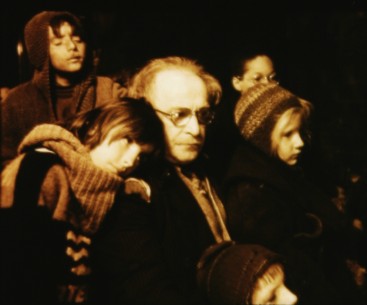
A nuclear catastrophe made the world unlivable. The main character, a professor ridden with guilt because his research contributed to the catastrophe, lives with a bunch of co-workers in the basement shelter of a museum. Soon, people are being moved to the central shelter but they won’t take the old and sick, so the professor is left behind with a few orphaned children. During all this time, he writes letters to his missing son reflecting upon what is happening around him.
I want to say “OK this was the most depressing film of the Berlinale ever”, but that was before I saw “O-bi, O-ba”, which was even more devastating because I inexplicably expected a black comedy with more funny scenes and less, uh, desperation. Truth to be told, “Letters from a Dead Man” is totally unbearable, even though it clocks in at less than 90 minutes. (Pip’s rule that films tend to be crappy when they have a runtime of 1 1/2 hours instead of 2 hours do not typically hold for films running at the Berlinale for sure.) I’m pretty sure that somewhere between minute 60 and 80 I could not stand the film anymore, though I decided not to look away (unlike when I saw “Snowpiercer”) because I found it worthwhile to experience the film as a whole. Nevertheless, the film consists entirely of a world that has turned bad, and it only gets worse, and worse, and worse. You can sense how strong the fear of a nuclear winter must have been at the time the film was made, whereas from today’s perspective it baffles my mind that anyone could even imagine the decline of humanity to look like this.
Overall, the film was one of the most visually striking Berlinale films I have seen and also the most thoughtful and carefully crafted. You can tell that the director has worked with Tarkovsky before, and the script, even down to the way the dialogues are written, just screams Strugatsky at you. Just thinking about it gives me goosebumps, and I am not sure I could handle another film based on something by the Strugatskys. I may even have chosen not to see the film if I knew what was awaiting me.
The film’s most devastating and most interesting aspect is its treatment of children (notably almost completely absent from “O-bi, O-ba”). Perhaps one of the hardest scenes to watch was the one where the professor tries to get into the sick children’s ward to find his son. On the other hand, I noticed immediately that the orphans were very pretty. Considering that everything and everybody else is old and ugly, the orphans are dressed cutely (as much as it is possible to look cute in dirt rags) and all have beautiful faces. It seems like a non-sensical unrealistic choice for a bleak film like this and at the end we finally learn that these children were crucial to the film’s ending. Because those children were so beautiful, I would interpret this ending as a hopeful and positive one, while the film overall is not exactly supposed to be realistic but an allegory of humanity itself.
In many aspects I think this film is a masterpiece, but its bleakness makes me reluctant to recommend it to anyone. I definitely did not enjoy it, not in the usual sense of enjoyment (hence you will see it relatively far down on my ranking despite my claim that the film is a masterpiece), but this is definitely the kind of film that makes me glad the Berlinale exists and gives you the opportunity to see something like this on the big screen.