Berlinale 2017, Day 7 (The Other Side of Hope)

This film was heavily anticipated. The old man actually asked me to buy two tickets for this screening for his friends, but I couldn’t do it because I wanted this time slot for Loris and myself. Due to the trains running late (yet again), I made it to the movie theater only 10 minutes or so before the film opened, even though I leave the house 1 1/2 hours early for almost every screening, and afterwards I had to rush to pick up O. In the end, it worked out fine but I didn’t actually meet the old man that day.

Of course it’s not necessary to see a Kaurismäki at the Berlinale, because his films are always available afterwards. But it was hands down the best film in this Thursday morning time slot, and Loris and I felt like seeing it, so there we are.

drrt

Toivon tuolla puolen (The Other Side of Hope)
Finland/Germany 2017, Aki Kaurismäki, 98′

Khaled is a Syrian refugee who more or less by chance ended up in Helsinki. He applies for asylum in Finland but gets rejected, so he decides to flee and stay in the country illegally. Wikström is a merchant and decides to leave his wife, give up on his former business of selling shirts and ties and open up a restaurant instead. While Khaled is homeless on the streets, he is discovered by Wikström behind the garbage bins. With the help of his three employees and their little dog, Wikström takes Khaled in, gives him a place to sleep and a job in the restaurant.

The verdict is pretty clear: How can anyone not like this film? Everybody I know including all the online reviews I read seem to agree that the new Kaurismäki is lovely in every aspect. If that refugee film didn’t win the year before, this one would have definitely gotten the Golden Bear. Much like “Le Havre”, “The Other Side of Hope” is optimistic, funny and has extremely lovable characters. In this case, the degree of lovableness goes through the roof, and everybody of relevance is either simply likable or a genuinely good person who does good things. What’s not to like?

One thing I noticed immediately was that the refugees are all pretty good-looking (the main character, the good friend, the sister) whereas all the locals are pretty ugly and/or old. It makes for an amusing contrast and I believe it also contributes to many comical situations.

Another thing I noted (a little later, of course) was that it took awhile until our main characters finally meet. It said it was 45 minutes in some review, but I had the impression it was more like one hour. In any case they spent at least half of the film not yet knowing about each other’s existence, which also means that you didn’t get to see them together that much. I thought it was the film’s only weakness: except for that scene in which they meet, there is not that much personal interaction between them. Their friendship is largely dependent on what they are (Finnish, Syrian) and much less on who they are, which I had been looking forward to.

Danish dude mentioned to me that the infamous Scandinavian unfriendliness or distance towards people is rooted in their impressively well functioning social welfare system. Just like how in Germany nobody gives you a seat on the subway no matter how much you look like you might need it, people in Denmark don’t make small talk with you, let alone become your friend, because they don’t meddle in other people’s affairs and believe that nobody needs their support, because the system will take care of it. As a result, expats in Copenhagen never meet or befriend any Danes, and leave the city because no social contacts are keeping them there. “The Other Side of Hope” shows a different aspect of Scandinavia… or it’s wishful thinking because in reality Finns don’t talk to each other either.

Finally, and this is so typically me, the dark ending of the film (and the shadow of violence cast upon it) was actually most memorable for me. It is an image that I can still recall very vividly, and it does make me wonder why all the reviewers and even I thought that the film was a feel-good movie. Of course the ending was beautiful, but with just that one violent scene at the end Kaurismäki managed to give a believable and realistic portrayal of a Finland that is not just composed of lovable, helpful people. It didn’t feel that way when I just saw it, but the more I reminisce about the film, the more I am devastated by the sadness of its ending. I think it was a masterpiece move of Kaurismäki’s to include this kind of dichotomy in “The Other Side of Hope”, and it reminds me that I need to see more of his films.

Berlinale 2017, Day 6 (A day after a hundred years, Uchujin Tokyo ni arawaru)

This was one of the weirdest screenings I have seen in awhile, mostly because the main feature was announced as “having a bad print quality, but the film is so great that [they] are showing it anyways” and the short film that came before was a silent film that was actually – gasp! – shown silent. Even when you don’t have live music, the film usually comes with some form of musical accompaniment, but here we actually watched the 11 minute film in complete silence. I thought it was the strangest thing, and the silence itself actually made me want to fall asleep. When the main feature finally started, I immediately felt a little more awake.

drrt

Hyakunen-go no aruhi (A Day After a Hundred Years)
Japan 1933, Shigeji Ogino, 11′

In 2032, scientists bring back the spirit of a man who died 90 years ago. The man is impressed by the technological advances and learns about life in the future.

Danish dude saw these two films on another day and said he thought the silent film was the worst film he has seen in awhile. I can definitely see where he’s coming from, because the animation is absolutely horrendous. Considering that the film came 3 years after sound films came about, it is shocking how badly it is made. Sure, I tend to have high expectations for animation but I don’t expect Kyoto Animation-like quality from everybody. But even if you take history into account, if Lotte Reiniger can make “The Adventures of Prince Achmed” mostly on her own, then the lazy art in this film has no excuse.

Nevertheless, I liked the film because the story spoke to me. I thought it was humorous and at times surprisingly accurate when it comes to predicting how the world would look like one day. Sure, magnet trains don’t look like they do in the film (the style of the futuristic architecture is actually decent, it’s just the handiwork in the execution that is sloppy) but it was very interesting to see how they imagined us almost 100 years ago. In fact, I even got a little confused about when the film was made because they were talking about some “Great World War” taking place around 1942, and I was impressed that the film seems to be prescient about these kinds of details. For me, this short film oscillates somewhere between impressively good and impressively crappy, but overall I think it did not deserve to sink into obscurity.

drrt

Uchûjin Tôkyô ni arawaru (Warning from Space)
Japan 1956, K?ji Shima, 87′

The appearance of UFOs and then of actual starfish-like shaped aliens sends the people of Japan into panic. It turns out the aliens are there to warn Earth from the impending collision of a big planet which would destroy all life on Earth, and later on help the humans to survive.

Uh yeah, I don’t personally agree with the claim that the film is great, although it definitely has many entertaining moments. The starfish-like aliens are cool and positively remind me of Neon Genesis Evangelion and Naru Taru, and until the middle of the film, I was highly entertained and very grateful for the humorous story (which was something I really needed this late at night).

I think I am just allergic to Japanese victimization, so the film took a quick turn for me when the “Japan is the only country that has suffered under nuclear weapons” threat came out. The film turns Japan into this poor little country at the mercy of the greater powers of the world, just a few years after it very much aspired to be one of those great powers. This is especially apparent when the children come into play – they are completely hopeless, faceless, always in fear of something and look frumpy and desolate in the way they are styled (very very not cute, unlike the children in “Letters from a dead man” where they manage to be active characters despite being catatonic). Needless to say it is the invention of a Japanese scientist that will save them all, not an American or another otherwise, and certainly not some technology brought in by the aliens, who are described as much more advanced than humans.

Maybe it’s unfair to judge a film based on these kinds of political considerations, but despite my enjoyment of the story otherwise I was honestly quite disturbed by the subtle nationalism of it, so there we are: I found both Japanese films of the day good and bad at the same time, so in that respect they are a perfect match for each other.

Berlinale 2017, Day 6 (Kurzfilme Kplus 1)

The event I have been anticipating for weeks is to attend a screening of the Berlinale with O. I saw that it’s recommended for 4 year olds (the only screening recommended for this young age group), and I was pleased to see that, of course, there would be plenty of overly eager parents with their 2 and 3 year olds. After 2 1/2 Berlinales of leaving O with my parents so I could attend the screenings, I am finally able to share the experience with him, yay!

We spent a very calm morning, took a nap from 10.30am to almost 1pm and got to the venue almost 45 minutes early. In fact, we were able to get in first and snatch two of those booster seat cushions such that Oskar’s head was almost at my height and he could see very well despite sitting in the comparably deeper (but very comfortable) special seats that you normally pay an additional fee for. The seats were so big that O asked “Have to put on your seat belt?”

It’s embarrassing to think about it, but when the Berlinale opening sequence was playing, I teared up, that is how much it meant to me that I am finally able to show the Berlinale to O. Ever since, O recognizes the Berlinale logo on all of my Berlinale bags…

As expected, O loved the experience. This was his first time in a cinema theater ever, and I was afraid he would be scared of the movie theater becoming very dark. I warned him beforehand and he saw that all the kids around him were not scared either, so it went very well. It helps that all the films were short, so even though there were some that he didn’t like as much (the second and the second to last) he was fine because he was anticipating the next story.

By the way, I ended up kicking out all other short film screenings from my Berlinale schedule this year because I somehow felt more like watching feature films this time. I saw a bunch of great short films with Shii in Uppsala, and I had doubts the Berlinale selection could surpass that.

After the film, we did not stay for the Q&A because O’s German is not good enough for him to understand and enjoy it, but we were able to get some postcards stamped with the adorable stamps by the same lady as 2015. O loved those stamps so much that he declared her film as his favorite – sounds like her marketing machine is working even better than I expected.

Later on, O was very excited all evening and it took him awhile to get settled for sleep, so I ended up leaving much later for my evening screening than I anticipated.

drrt

Sabaku
Netherlands 2016, Marlies van der Wel, 3′

A bird loves to sit on top of other animal’s heads, but whenever he opens his mouth, a huge loud trumpeting sound comes out and chaos ensues. Finally he gets to meet an elephant with whom he becomes best friends and they trumpet together while the bird sits on his head.
The kids loved aforementioned ensuing chaos, and O liked that there were lots of animals involved, but he didn’t seem to find it as funny as the other kids. I thought the film was cute, and a nice allegory on how everybody can find a suitable friend.

Dziedošais Hugo un vi?a neticamie piedz?vojumi (Singing Hugo and His Incredible Adventures)
Latvia 2017, Reinis Kalnaellis, 9′

Hugo, a chicken in a chicken coop, dreams of becoming a big star but his singing disturbs the other chicken and gets him abducted by chicken thieves. He gets sold to various places, a crazy chase ensues and Hugo accidentally ends up at a circus performance where he finally fulfills his dream.
I thought the story itself was enjoyable and nice, but the character design is significantly less cute than for most of the other segments, so O was less into it. I doubt O was a big fan of the action (or the sleazy human characters) either.

Odd er et egg (Odd is an egg)
Norway/Portugal 2016, Kristin Ulseth, 12′

Odd is the child of chicken and his head is essentially an egg that may break and thus needs a lot of attention and care. As a result, Odd has no friends because he can never play along with their dangerous ball games and the likes. One day, he meets a girl who dresses up like a bee and whose free spirit inspires him to shake off his fears, and she becomes his first precious friend.
When I saw that the story would involve an outcast school-aged child, I was worried that O would think the topic to be boring. I was so wrong, because the story was mostly about Odd and Gunn becoming friends – and O loves that! Even though he understood relatively little about what was said in the dialogues, he grasped that this is a heart-warming tale of two children becoming friends and doing fun things together, and that made him happy. I thought it was adorable too, even if the premise and the ending are also a little silly.

1Minuutje natuur (1Minute of Nature)
Netherlands 2016, Stefanie Visjager/Katinka Baehr, 7′

The film consists of five little segments of children talking about something of their lives for one minute, with some matching animation using stick characters and real-life objects as backgrounds.
I was not too into the style and O didn’t get how the animation illustrated what has been said. This film is actually a little more advanced than the others, but without really saying that much if you ask me. It was OK.

Der kleine Vogel und die Raupe (The Little Bird and the Caterpillar)
Switzerland 2017, Lena von Döhren, 4′

The little bird from two years ago still cannot fly, and befriends a caterpillar in this story who helps him get away from the mean fox.
Just like last time, this was extremely cutely animated and it surely helps for O that it had no dialogue at all. It seems like the films about the little bird are favorites with the audience every time. As for me, I already forgot what happened in the story, but I am glad that O had a good time and treasures his stamped postcard so much that it’s now hanging on his wall.

Hedgehog’s Home
Canada/Croatia 2016, Eva Cvijanovic, 10′

The hedgehog lives in modest housing within the forest. One day, the fox invites him to his house and offers him to stay over, but the hedgehog still prefers to go home. It’s a little tale about how your own home is always the best.
This is a classical fable with lots of dialogue and the animation is often dark and a little intimidating looking, especially with a bear, a fox and a wolf as characters. No wonder O wasn’t too into it, even though I thought the story itself was actually fine.

Jazzoo
Sweden 2016, Adam Marko-Nord, 9′

In these ultra short segments, various animals are doing fun things accompanied by jazzy music.
To me, this was the most humorous part of all of them, O really liked the colorful animation and the animals that were involved (in fact, it seems like he had a dream concerning one of the segments afterwards and then claimed he saw it in the cinema), and we were both very into the music. Sadly the parts were also so short that the content was ultimately not very memorable, but even so I remember I found it to be one of the best and most entertaining short films in the selection.

Berlinale 2017, Day 5 (Requiem for Mrs. J)

I just spent an hour waiting in line for tickets, another hour waiting for O to arrive, another 2 1/2 hours in which we sat through a ballet (he was watching intently throughout its entire course while I almost fell asleep) and another hour getting home together. Now it’s 11pm and I’ve been wanting to sleep since 8pm or so. Bottom line: I feel reminded of that morning after seeing “Call me by your name” when I rushed to get to “Requiem for Mrs. J” by 9.30am. Thankfully it worked out well time-wise, but having slept some 5 hours or so I knew beforehand that I’d fall asleep. (Amusingly, Loris told me I slept through a sex scene when I was noting that I hadn’t seen any during this Berlinale.)

There was also a Q&A at the end which Loris attended but I ran back home to get some sleep before picking up O again, and I looked forward to resting before the next day, which was my most anticipated day of all.

drrt

Rekvijem za gospodju J. (Requiem for Mrs. J)
Serbia/bunch of other countries 2017, Bojan Vuletić, 94′

Jelena lost her job, and ever since her husband’s death almost a year ago, there is nothing in life for her. She decides to kill herself with a pistol on the day her husband died, but till the week is over, she has to put things in order: She needs to cancel her life insurance, get her name onto her family grave stone, re-new her health insurance card. Every step seems to get more complicated than the previous one, leading to kafkaesque scenes.

I had pretty high hopes for this film, and I wouldn’t say it was bad. In theory, this film could have been right up my alley: I like the subtle black humor it suggests in its title, and the general premise of a woman who wants to prepare her own suicide but meets crushing bureaucracy and a rigid societal system. Sounds like something I like, right?

While Loris was really into the film, I have no idea why the film didn’t click with me at all. Maybe I was too tired to sit through a slow-paced film (but I was tired when I saw “45 Years” so that doesn’t count), maybe I have too little knowledge or understanding for the circumstances in Serbia, maybe I just didn’t find Jelena compelling enough as a character because she actually did very little in the film. The last scene, which I could tell was set up to be an emotional, almost hopeful ending, left me rather non-plussed.

However, the most noticeable part for me was Jelena’s relationship with her daughter. I absolutely understood the daughter’s complaints about her mother not doing anything around the house (she literally sits by the table a lot), when rationally I know that Jelena, having recently lost her job and her husband, would have no interest in housework. But in the way she was portrayed I had a hard time getting on her side on the emotional level. (Perhaps in a different medium, like a book, this would have been different.) I also didn’t really buy how the daughter ended up reconciling with her mother based on nothing (or so I felt). It’s not like she knew that her mother was (essentially) coming back to life, and it’s not like her situation or their relationship had actually changed for the better.

I have a soft spot for films from Eastern Europe, and I doubt that will change with this one, because from what I remember it’s the first of its kind ever that somehow didn’t work for me.

Berlinale 2017, Day 4 (Call me by your name)

Like most people I know who go to the Berlinale, I avoid the gay movies. Of course I make conscious exceptions like I did for “Love is Strange” (largely because I am into Alfred Molina and John Lithgow and liked the premise a lot), but when it comes to the Berlinale the genre is famously oversaturated so the likelihood of stumbling upon something great (like “Weekend”, in my mind perhaps the greatest gay film ever) is so small that I usually wouldn’t run the risk.

In this case, I completely failed to realize that this is a gay movie. (Can you believe it?) I thought “oh there is a new movie by the director of ‘I am love’ and I have not seen an Italian film in awhile”, and that was enough for me to choose this film without looking at the synopsis too closely.

It was also the first time I saw a late screening at this year’s Berlinale, and the first thing I noticed about the film was that it managed to keep me awake even though I felt really, really tired. Even though I was at the premiere of the film, I couldn’t be bothered to stay for the Q&A afterwards.

drrt

Call me by your name
Italy/France 2017, Luca Guadagnino, 132′

Every year, Elio’s family takes in a young archaeological researcher at their summer villa to stay with them and to help Elio’s father with his research. This year, the visitor is a charming and exceeding good-looking American who first confuses Elio, but slowly they realize their feelings for each other.

It’s difficult not to compare the film with “I am love”, so I will unashamedly do so. What struck me the most was how incredibly unusual “I am love” is as a film, and how straight-forward the love story plot in “Call me by your name” is compared to it. How can a director who cooks up some of the most unusual stories make another movie about something so trivial? Not that it is necessarily a bad thing – boy meets girl (in this case boy meets boy) can be nice and interesting – but I just expected otherwise from this director. I was especially into the family relationships in “I am love”, which I felt was sorely missing here. All the other characters just served as supporting cast to the main characters’s relationship. Literally supporting in fact.

That was another thing that surprised me a little – the relationship has absolutely no challenges outside of itself. That can be nice too, but in this case the parents and girlfriends (!) seemed over the top helpful. The parents freely discuss their son’s relationship: “Oh our 17 year old son’s boyfriend is leaving and he will be heart-broken so why don’t we send them on a short city trip so they can intensify their feelings further before he leaves?” The girlfriend Elio toys with and essentially dumps by not talking to her for 3 days says stuff like “I don’t want to get involved with you. I have a sense that you will hurt me and I don’t want to be hurt” prior to entering a relationship with him anyways (of course), but after getting dumped and after Oliver leaves, she (almost literally) says this to Elio: “I heard about Oliver leaving, and I’m sorry that you are sad. It’s alright, I am not angry at you, I really am not. Can we still be friends? I love you, Elio.” What the heck?

If one accepts that “Call me by your name” is the ultimate gay high society utopia, the film can be thoroughly entertaining (as I hinted before, I did not fall asleep during it) precisely because everything was so utopic and idyllic. Just like “Love is strange” (and also like “I am love”) the characters live in this perfect world of thoughtful intellectuals in which they have a scrumptious breakfast in their Italian garden, with fresh orange (or other) juice, croissants and fruits from their orchard. When the father and Oliver talk about their archaelogical research (and claim that those ancient sculptures of males were erotic), the mother comes in with more freshly squeezed juice in a jug and pretty cups on a tablet. Their cook makes the most delicious looking foods, and they all casually switch between their three languages within any conversation (French, Italian, English). Oh and they are Jews too!

I was amused to see that Louis Garrel’s sister is somehow just completely normal-looking, much like Chiara Mastroianni. The girls in the film are all comparably average-looking, whereas the main characters look more like of a combination of Shii and Louis Garrel himself (Elio), and Don Draper in blonde (Oliver). Alfred Molina and John Lithgow make for a more realistic couple in “Love is strange”, but as I said, you just have to accept the utopia “Call me by your name” lives in, and then the film becomes a fun escapist fantasy. (OK, the sex scenes were boring. At some point 2/3 into the film, the physical aspect of their relationship became important and I yawned throughout it pretty heavily.)

Oh, I also like the gimmick with the title (which I completely failed to realize until it was shown at the end of the film). It’s cute, and it reminded me of “You’re ugly too”.

Berlinale 2017, Day 4 (Test pilota Pirxa)

After a very long Sunday (lining up for tickets, have brunch, watch 3 films) my Berlinale week (Monday-Thursday) essentially consisted of a film in the morning and then another one or two in the evening. Unsurprisingly, I fell asleep during many of them, with this film being the first one. In retrospect it was a shame, and I have the suspicion that falling asleep actually made me appreciate the film more than I maybe would have otherwise, because the others who attended it (Loris, Danish dude) did not seem to be big fans of it. As a result, the insecurity over what to think about this film combined with my falling asleep actually made it harder for me to blog this film than “Letters from a Dead Man” where I had anticipated it would be tough.

This is also the only film that I placed into the “after O comes home from daycare and before he goes to sleep” time slot which I normally try to spend at home, because I really, really wanted to see it. My dad was very nice and came home early from work, but then it took me almost 1 hours 45 minutes to reach the movie theater, and I got there 5 minutes before the screening started.

drrt

Test Pilota Pirxa (Pilot Pirx’s Inquest)
Poland/USSR 1979, Marek Piestrak, 99′

As human-like androids (“nonlinears” as they are called in the film) are being built, it is being discussed whether they should be allowed for mass production. In order to test whether the nonlinears are capable of replacing humans, Commander Pirx is sent with a 5-man crew to Saturn and tasked to make a recommendation on whether mass production of such robots is appropriate. Among these 5 men, some are human and some are nonlinears, but Pirx does not know who is what. When they reach Saturn, one of the nonlinear crew members tries to sabotage the whole operation and kill the human crew in the process…

First of all, I went into the film not really knowing what the story would be about, I just read “based on stories by Lem” and saw the title and that was enough for me to pick the film. I think I fell asleep when the committee decided upon giving Pirx this important task, and I woke up when the first guy started telling Pirx whether he was human or not (and make assumptions about what the others may be). This is the kind of premise or mystery that I am really, really into. I enjoyed the human-robot interaction, the crisis that the rogue robot provoked and this concept that human weakness ended up winning over the perfection of the robots.

I was also into the courtroom drama that came at the end. Loris thought that it was too much telling and not enough showing, but I didn’t notice that at all. The discussion was much about the nature of humans vs. robots and reminded me of that famous Data episode in Star Trek The Next Generation.

Unlike “Ikarie XB 1” and some of the other titles at the Berlinale which apparently were quite influential, “Test Pilota Pirxa” seems to be an utterly obscure title with pretty unimpressive visuals and a nice but not overly innovative story. As for me, I’m quite into said story. Moreover, It’s still bugging me that we never get to learn whether the awkward engineer was human or nonlinear. I know that his antics were primarily comic relief and of little consequence for the rest of the film, but I cannot help but wanting to know.

It amused me quite a bit to see that the film was a partially Estonian production, and very popular in Estonia where kids grew up with the film and fondly remember it as adults today. (As for me, I thought Arvo Pärt’s music made for a great accompaniment to the film.) I can definitely see how the film would be memorable for a 10-12 year old.

Maybe I fell asleep through the boring parts of the film, and maybe it is true that there are better ways to handle the human-robot interaction topic, but for me the film was perfectly suspenseful and enjoyable. Since it’s always pretty easy to motivate Pip to watch a sci-fi movie, perhaps I will have a chance to revisit this film one day.

Berlinale 2017, Day 4 (Up in the Sky)

This was quite an experience. I have never been in the Haus der Kulturen der Welt, and I was quite afraid I wouldn’t get there in time since you have to take a bus there (and the 100 bus is not exactly famous for being very punctual). Luckily I got a bus right away (and I caught the shuttle bus on the way back too). In the end I was there 25 minutes early and was able to get a very good seat, even though I was sitting inmidst of a crowd of children. It turned out that this was a good thing, because kids talk to their friends and so I was able to hear firsthand what they thought about the film. They would comment “oh it’s so cute!” about the little robot, laugh out loud many times and generally be very vocal about their thoughts (largely they were ecstatic and loved it to pieces).

The screening also came with a Q&A but I was too busy to stay for its entirety, which is especially sad for this film because I really enjoy the questions asked by children. (Actually I didn’t really stay for any Q&A’s this year at all because there were so many other things going on at the same time. By the time I got less busy, the Berlinale was almost over and there were no Q&A’s anymore.) I listened for a few minutes and learned that the film’s puppet characters were actually part of a children’s TV series and the director designed the puppets and originally trained as puppeteer. Also, the little girl who plays the main character seems really professional and ambitious, the kind who has always dreamed of making it big as an actress. I actually wanted to learn more about the film, and find these Q&A’s to be one of the most interesting aspects of the Berlinale overall, but I have no regrets.

drrt

Upp i det blå (Up in the Sky)
Sweden 2016, Petter Lennstrand, 82′

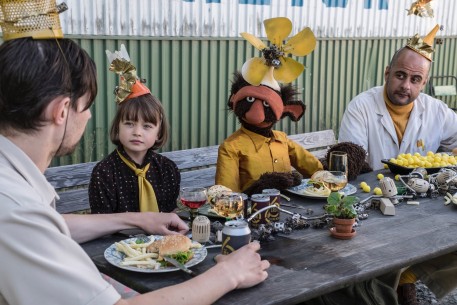
Pottan’s parents are very busy and want to drop her off at a pony farm. Accidentally, she ends up at a recycling yard instead, where the team consists of a puppet who is supposed to be the boss but actually just talks a lot, an older puppet who likes to tinker with recycled things and a wanted criminal hiding out at the recycling yard. After they take in Pottan, she finds out that the chaotic but lovable group is trying to build a space ship, and soon they go on a quest to find a real rocket scientist to fulfill their dream.

Well, what can I say, “Up in the Sky” is the perfect children’s movie. It has wonderfully lovable, quirky characters tied together by a sweet friendship, even though or maybe because they all come with their own weaknesses. The film is funny, energetic and very knowledgeable about what children would get excited about in a story. Pottan is largely a generic main character, but she is not the kind of child adults imagine children would be like, but actually someone a child could relate to. Also, the kids in the audience especially loved the action-packed scenes in the second half of the film. Heck they even managed to work in a martial arts fighting scene.
I only found the busy parents a little over the top, because they go from completely not caring about her to suddenly becoming very attentive, but within a children’s movie this kind of exaggeration is fine, I suppose.

Did I ever mention that I think the name Pottan is really cute? I have a suspicion this cannot possibly be a real name, and a quick search on the internet suggests so as well.

I hope O will be ready for this film in a few years, and I think it’s actually a much more sophisticated and enjoyable film than most children’s films I have seen in the last few years. (Considering that just last year I saw “Zootopia”, “Finding Dory” and “Paddington”, this is quite a feat.)

Berlinale 2017, Day 3 (Ropaci, Ikarie XB 1)

As I mentioned before, I was pretty frustrated by not getting into “Droles d’oiseaux” which I kind of planned on but instead spent over three hours doing essentially nothing. I had a book with me but couldn’t really get into it, and shopping is strangely not fun when you are not in the mood for it. I was glad when that was over and my final screening of the day started.

drrt

Ropaci (Oil Gobblers)
Czechoslovakia 1988, Jan Sv?rák, 22′

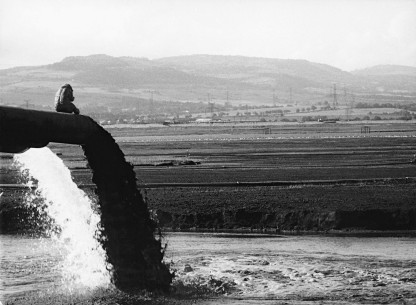
A team of 4 researchers and cameramen are looking for signs of a new species, the oil gobblers. They live in toxic smoke, eat rubber and drink petroleum, and in fact are only able to survive in polluted industrial environments.

I’d describe the film as satirical pretend documentary (I guess you call that a “mockumentary”), and as you may all know, I love quasi-documentaries like “District 9” and “My Winnipeg”. While I am often bored by actual documentaries, I really like it when I see a film playing with the medium and giving it a more or less fictional twist.

I never though that “Ropaci” was as laughing out loud funny as some people did in the audience, but it’s definitely a film that could have been longer and still be interesting. Apparently it’s become some sort of cult film, and it made quite an impact on the audience at the time because people actually took it serious. I thought that anyone who could take it seriously must have a pretty bleak outlook on society and technological development, but maybe people expected both the best and the worst of technology back in the day.

Other than that, I thought the film had a very clever premise, and despite not explicitly laughing, I found it enjoyable throughout the course of its short run.

drrt

Ikarie XB 1
Czechoslovakia 1963, Jind?ich Polák, 88′

Based on a Lem story, Ikarie XB 1 is a spaceship with 40 men on the way to Alpha Centauri looking for alien life. First, they stumble upon an empty spaceship from a long time ago, then they all fall sick because a dark star is drawing out their energy and finally, one of them has a mental breakdown and he threatens the life of the entire crew.

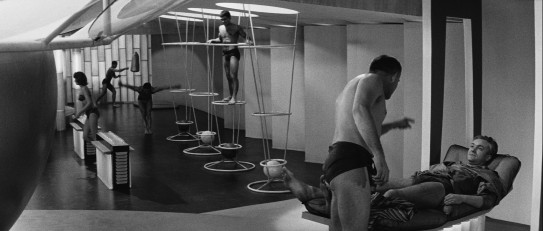
First of all, I thought it was notable how incredibly stylish the film was. Much like “Himmelskibet”, its production values are impressive and the sets, the character and costume designs are absolutely impeccable. I can see how the film inspired Kubrick for “2001” because this is such an unabashedly pretty film. It also comes with psychedelic music and a very good-looking dance and party scene.

When it comes to the substance, however, I thought the film had very little of it compared to other highly acclaimed science-fiction films of the time. Even Eolomea, the almost satirical comedy, is serious about the questions it’s asking. Ikarie XB 1 is largely an adventure story, and it took me awhile to realize that it is almost a slice of life that moves from one little challenge to another little challenge throughout the film. For me, it probably would have worked better as a mini-series with each episode focusing on one of the adventures of the crew. Thinking about it, “2001” is a little bit like that too (it is subtitled “odyssey” for a reason). However, I think nothing can really compare to “2001” since that one is ultimately a unique and wacky film, much unlike Ikarie XB 1 whose story is comparably more generic.

The film ends on a very hopeful, positive note with a baby being born and the crew realizing that benevolent aliens must have helped them to get out of the grip of the dark star, so the film actually manages to have a kind of conclusion after being quasi-episodic for so long. I thought that was a nice idea, just like watching the film was generally very satisfying.

Berlinale 2017, Day 3 (Letters from a Dead Man)

The best thing about having two films back to back at CinemaxX 8 is that they let you stay in the theater, and you just show them your ticket for the next film while inside. That way you are guaranteed to get your preferred seat because each time, only around 5-6 people end up staying. Actually I have never had a chance to try this at any other venue, but whenever I can, I jump at the chance to catch two Retrospektive films in a row. I almost went for four of such films, but realized that this may be too crazy after all (though “Strange Days” seems to be an interesting movie).

This is the first film I saw with somebody this year (if you don’t count that random meeting with Danish dude). Pixelmatsch didn’t really have much time nor the energy to attend, and neither Shii nor 6451 came to Berlin. As a result, this Berlinale was sadly not its usual social event for me, although I did end up catching a total of 6 films (I think?) with Loris this year.

Let me preface this review with a disclaimer: I am really eager to stick to my “4 postings per evening” rule this time (for those evenings where I am home and able to blog), because normally “Letters from a Dead Man” is the typical kind of film that sends me into a writer’s block. This year, however, I am trying to avoid spending a month blogging the Berlinale by not over-thinking the blogging. Even though I want to spend time reflecting upon the films, I don’t want to write my afterthoughts after all those fresh feelings are over and I only remember half of what had happened. And hey, I can still add things to the postings later after all.

drrt

Pisma mjortwowo tscheloweka (Letters from a Dead Man)
USSR 1986, Konstantin Lopuschanski, 87′

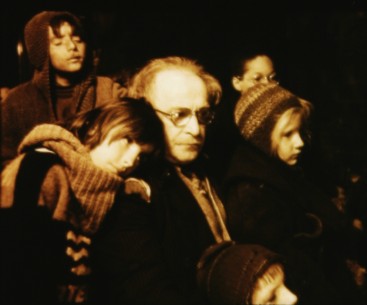
A nuclear catastrophe made the world unlivable. The main character, a professor ridden with guilt because his research contributed to the catastrophe, lives with a bunch of co-workers in the basement shelter of a museum. Soon, people are being moved to the central shelter but they won’t take the old and sick, so the professor is left behind with a few orphaned children. During all this time, he writes letters to his missing son reflecting upon what is happening around him.

I want to say “OK this was the most depressing film of the Berlinale ever”, but that was before I saw “O-bi, O-ba”, which was even more devastating because I inexplicably expected a black comedy with more funny scenes and less, uh, desperation. Truth to be told, “Letters from a Dead Man” is totally unbearable, even though it clocks in at less than 90 minutes. (Pip’s rule that films tend to be crappy when they have a runtime of 1 1/2 hours instead of 2 hours do not typically hold for films running at the Berlinale for sure.) I’m pretty sure that somewhere between minute 60 and 80 I could not stand the film anymore, though I decided not to look away (unlike when I saw “Snowpiercer”) because I found it worthwhile to experience the film as a whole. Nevertheless, the film consists entirely of a world that has turned bad, and it only gets worse, and worse, and worse. You can sense how strong the fear of a nuclear winter must have been at the time the film was made, whereas from today’s perspective it baffles my mind that anyone could even imagine the decline of humanity to look like this.

Overall, the film was one of the most visually striking Berlinale films I have seen and also the most thoughtful and carefully crafted. You can tell that the director has worked with Tarkovsky before, and the script, even down to the way the dialogues are written, just screams Strugatsky at you. Just thinking about it gives me goosebumps, and I am not sure I could handle another film based on something by the Strugatskys. I may even have chosen not to see the film if I knew what was awaiting me.

The film’s most devastating and most interesting aspect is its treatment of children (notably almost completely absent from “O-bi, O-ba”). Perhaps one of the hardest scenes to watch was the one where the professor tries to get into the sick children’s ward to find his son. On the other hand, I noticed immediately that the orphans were very pretty. Considering that everything and everybody else is old and ugly, the orphans are dressed cutely (as much as it is possible to look cute in dirt rags) and all have beautiful faces. It seems like a non-sensical unrealistic choice for a bleak film like this and at the end we finally learn that these children were crucial to the film’s ending. Because those children were so beautiful, I would interpret this ending as a hopeful and positive one, while the film overall is not exactly supposed to be realistic but an allegory of humanity itself.

In many aspects I think this film is a masterpiece, but its bleakness makes me reluctant to recommend it to anyone. I definitely did not enjoy it, not in the usual sense of enjoyment (hence you will see it relatively far down on my ranking despite my claim that the film is a masterpiece), but this is definitely the kind of film that makes me glad the Berlinale exists and gives you the opportunity to see something like this on the big screen.

Berlinale 2017, Day 3 (Himmelskibet)

Day 3 marks an amusing shift in this year’s Berlinale. It was one of the most interesting days which I have been looking forward to (I saw 3 films in the CinemaxX 8 almost in a row), but spending the entire day with the Berlinale (starting with buying tickets in the morning) and having failed to get into one film (Droles d’oiseaux) actually dampened my enjoyment of the Berlinale overall. Every year something frustrating will happen at the Berlinale, but typically this lasts only a day or so. In this case, a fantastic film the next day (Upp i det bla) made me all but forget the frustrations of the day before.

Actually buying tickets was fun on that day, because I met up with the old man from two years ago who got there earlier than me, so being 5th in line, we were easily able to get all the films we wanted. The other fun occurrence of the day was that I got into a conversation with the person standing in line after me when we waited to be let into the movie theater for “Himmelskibet”, and we ended up chatting and meeting up several more times over the course of the Berlinale. Seems like the Berlinale is really turning into an event during which I randomly meet people!

Yet again, the cinema was packed for this screening. I asked aforementioned person why he chose to attend the screening and he said he was Danish and wanted to see the Danish offerings at the Berlinale (so he shall be referred to as Danish dude from now on). As for me, I chose the film because it’s a silent film with Stephen Horne’s live accompaniment, of course.

drrt

Himmelskibet (A Trip to Mars)
Denmark 1918, Holger-Madsen, 90′

I can see why the person introducing the film seemed so proud of their restorative work on the film, and why he felt compelled to excuse the film’s absurd airplane-rocket (this is probably because neither he nor the audience have ever heard of the term “steampunk”). On the one hand, “Himmelskibet” looks outdated and comes with an absurdly one-dimensional story and even more cookie-cutter characters than “Algol”. On the other hand, it’s actually a surprisingly well-made film for being one of the first of its kind, and there are many grand scenes and aereal shots suggesting that there was incredible monetary support for the film. For being so outdated looking, the Martians actually look awfully much like the hippies that came almost 50 years later.

The other thing “Himmelskibet” has going for it is that it’s a pacifist WWI film without being so obnoxiously nationalistic and misguided as “J’accuse”. This film is a straight-forward utopia fantasy where the aliens are portrayed as 100% wonderful and ready to come save the Earthian world from all its perversions. It’s only when keeping in mind that WWI was still raging when the film was made that the over the top simplicity of the film’s story makes sense. This is perhaps a film that must be viewed from its history more than most other films, but within its context, it actually conveys a sweet message that we simply have trouble accepting nowadays, maybe because we now have lost that innocence and hopefulness. History may repeat itself, but utopic ideologies probably don’t.

On a side note, I realize I haven’t seen a Danish film in forever. Back in the day, I was really into the Emolars movies, I loved “Festen” and “Adam’s Apples”, and then Gorp got me into seeing some Dreyer films, but I still have not seen “Häxan” nor “Babette’s Feast” which I had been planning to forever, and none of the Dogme 95 directors seem to be doing anything interesting anymore.